Exporting almonds from the United States is straightforward only after the destination rules are clear. The product, buyer, label, treatment, and certificate requirements must agree before the exporter books freight. This guide turns that work into a shipment-ready sequence and separates mandatory U.S. filings from buyer-requested documents.
The short answer
Confirm the product form and 10-digit Schedule B code, verify the destination's plant-health and food rules, qualify the buyer, agree the specification and Incoterm, prepare certificates before loading, file EEI when required, and keep every commercial document consistent.
The market in one chart
California's 2024/25 crop-year shipments totaled 2.646 billion pounds. Exports accounted for 1.975 billion pounds, or 74.6%, according to the Almond Board of California's July 2025 Almond Industry Position Report. Chart labels are rounded to the nearest million pounds.
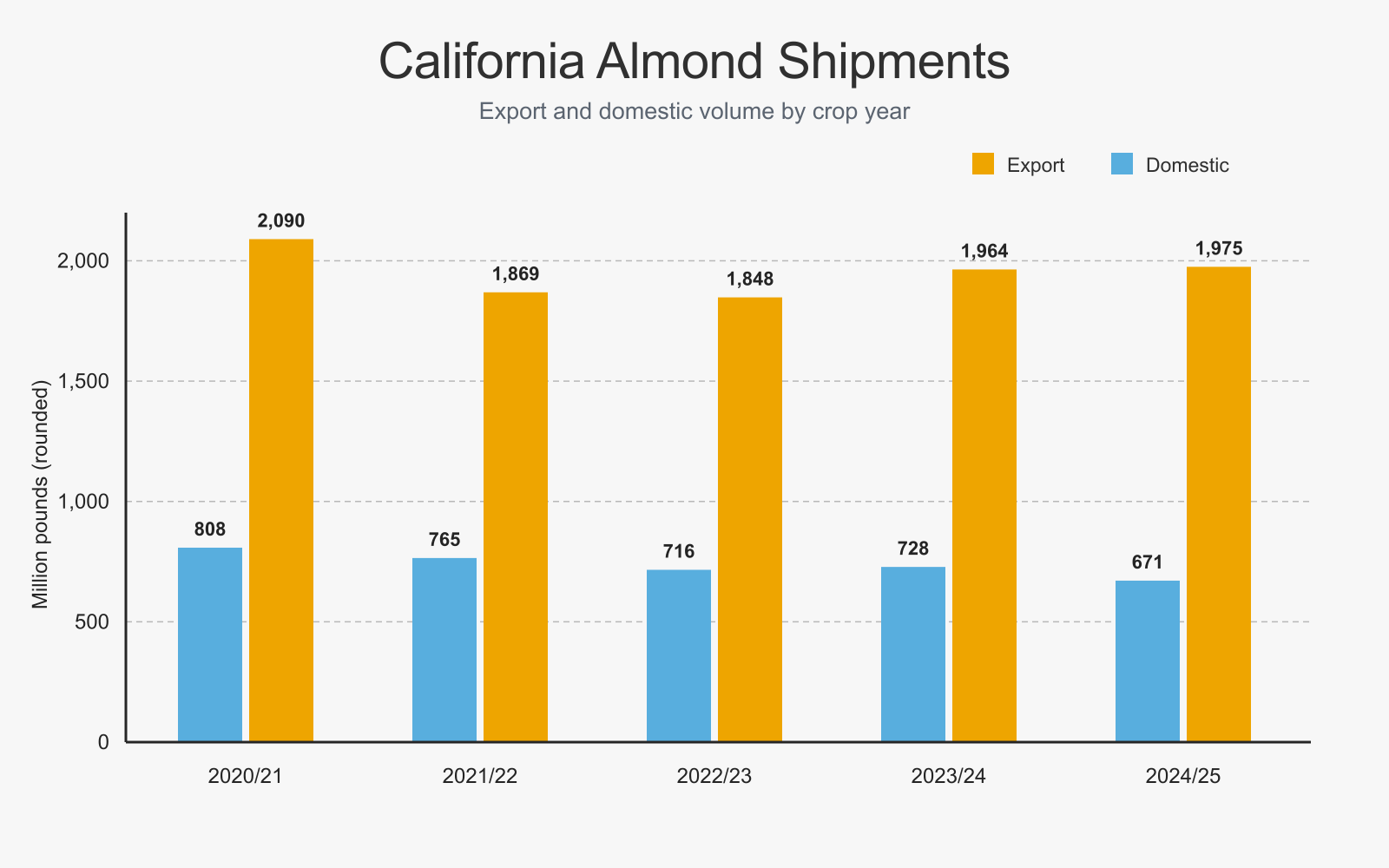
The opportunity is not one market or one product. India is the largest destination by volume, while Spain, the United Arab Emirates, the Netherlands, Turkey, Germany, Italy, and Japan serve different retail, ingredient, processing, and re-export channels.
1. Define the product before you quote
An accurate quote starts with an exact product specification. “Almonds” is not enough. Record the form, variety, size, grade, crop year, treatment, pack size, net weight, shelf life, allergen statement, and any organic or buyer certification.
| Product decision | Why it changes the export |
|---|---|
| In-shell or shelled | Changes the Schedule B code, destination demand, inspection profile, and freight economics. |
| Natural or processed | Blanched, roasted, salted, coated, mixed, paste, and butter products may classify outside the raw-almond lines. |
| Bulk or retail packed | Retail packs bring destination-language, nutrition, allergen, date-marking, and importer-label requirements into scope. |
| Conventional or organic | Organic claims require a valid certified chain and destination-accepted documentation. |
Ask the buyer to approve a written specification and label proof. This prevents a common failure: a compliant almond lot arriving with packaging the importer cannot legally sell.
2. Use the correct Schedule B code
The 2026 U.S. Schedule B lists the two basic raw-almond export codes below. The six-digit HS family is useful for market research, but the exporter or filing agent normally needs the full 10-digit U.S. code for EEI.
| Schedule B | Description | Unit |
|---|---|---|
| 0802.11.0000 | Almonds, in shell | kg |
| 0802.12.0000 | Almonds, shelled | kg |
Do not force roasted, salted, sweetened, coated, mixed, or prepared products into these codes. Check the current U.S. Census Schedule B, then confirm the destination's tariff code separately because national tariff lines can extend beyond the six-digit HS level.
3. Confirm destination access before accepting the order
There is no single worldwide certificate pack for almonds. Requirements depend on the destination, product form, treatment status, origin, and intended use. Start with the importing country's permit or official requirement, then check the USDA APHIS Agricultural Commodity Import Requirements database.
Resolve these questions in writing:
- Does the destination require a phytosanitary certificate for this exact almond form?
- Are there treatment, fumigation, pest-free, or additional-declaration conditions?
- What are the aflatoxin, microbiological, pesticide-residue, and moisture limits?
- Does the importer need a prior permit, facility listing, or product registration?
- Which language, nutrition, allergen, origin, lot, and date statements must appear on the label?
If a phytosanitary certificate is required, apply through APHIS PCIT and arrange inspection early enough to meet the vessel cutoff. A buyer's request alone is not a substitute for the official destination condition.
4. Check the exporter, facility, and transaction
Most ordinary food exports do not need a product-specific Commerce export license, but every exporter should screen the buyer, consignee, banks, and other parties using the U.S. government's Consolidated Screening List. Resolve any match before shipment.
FDA registration is not a universal almond export license. FDA's food-facility registration rules generally apply to facilities that manufacture, process, pack, or hold food for consumption in the United States, subject to exemptions. A destination may separately require an FDA export certificate or facility listing. Check the actual facility activity and destination requirement using FDA's food-facility registration guidance and food export certificate guidance.
If you source from a handler, obtain the handler's current specification, traceability record, treatment status, food-safety certificates, and certificate-of-analysis capability before promising them to the buyer. The USDA AMS almond marketing order is the official starting point for handler and program background.
5. Qualify the buyer and agree the commercial terms
A credible importer should be able to provide its legal name, registration or tax number, delivery address, import-permit position, bank details, preferred customs broker, product specification, and required documents. Match those details across the purchase order, sanctions screening, and payment instructions.
| Term to settle | What must be explicit |
|---|---|
| Incoterm | Named place or port and the current Incoterms edition, not just “FOB” or “CIF.” |
| Payment | Advance, confirmed letter of credit, documentary collection, insured open account, or another agreed method. |
| Quality acceptance | Sampling method, laboratory, tolerances, claims window, and treatment of non-conforming lots. |
| Shipment window | Required departure/arrival dates, permitted transshipment, partial shipment, and document deadlines. |
6. Build the document pack
The final pack depends on the destination and contract, but most shipments begin with the same commercial core.
Commercial and transport documents
- Commercial invoice with consistent seller, buyer, description, Schedule B/HS reference, origin, value, currency, and Incoterm.
- Packing list with package count, net and gross weights, lot numbers, pallet count, and container details.
- Bill of lading or air waybill matching the agreed consignee and notify party.
- EEI/AES filing citation or exemption statement, as applicable.
- Certificate of origin when the buyer, bank, customs authority, or preference claim requires it.
Product and destination documents, when required
- Phytosanitary certificate and any required additional declaration.
- Certificate of analysis for aflatoxin, microbiology, pesticide residues, moisture, or buyer specifications.
- Treatment or fumigation certificate.
- Grade/specification sheet and lot traceability record.
- Organic, halal, food-safety audit, insurance, or destination-specific certificates.
Letters of credit are literal: product names, dates, weights, ports, consignee details, and document titles must match the credit. Review the draft documents before the container reaches the terminal.
7. File EEI when the rule requires it
Electronic Export Information is generally required when goods under one Schedule B number exceed USD 2,500 from one U.S. Principal Party in Interest to one consignee on one conveyance, or when another mandatory filing rule applies. Canada has separate treatment and exceptions. Use the current Foreign Trade Regulations and filing guidance for the actual transaction.
A freight forwarder can file as an authorized agent, but the exporter must still provide accurate classification, value, origin, parties, and license information. Keep the Internal Transaction Number and supporting records with the shipment file.
8. Pack for the voyage, not just the warehouse
- Use clean food-grade bags, cartons, liners, or bulk packaging suited to the almond form.
- Control moisture and odor exposure; inspect the container before loading.
- Use lot codes that connect every package to the specification and certificate of analysis.
- Verify shelf-life assumptions against transit time and destination storage conditions.
- Ensure wood packaging, if used, carries valid ISPM 15 marks where required.
- Photograph packaging, seal, container number, and loading condition for the file.
Retail labels should be approved by the importer before printing. Almonds are tree nuts, so the destination's allergen declaration rules deserve a specific review rather than a generic “contains nuts” line.
Where U.S. almonds shipped in 2024/25
The latest complete crop-year data puts India well ahead of other destinations at 423 million pounds. Spain and the UAE follow, with the Netherlands, Turkey, Germany, Italy, and Japan forming the next group.
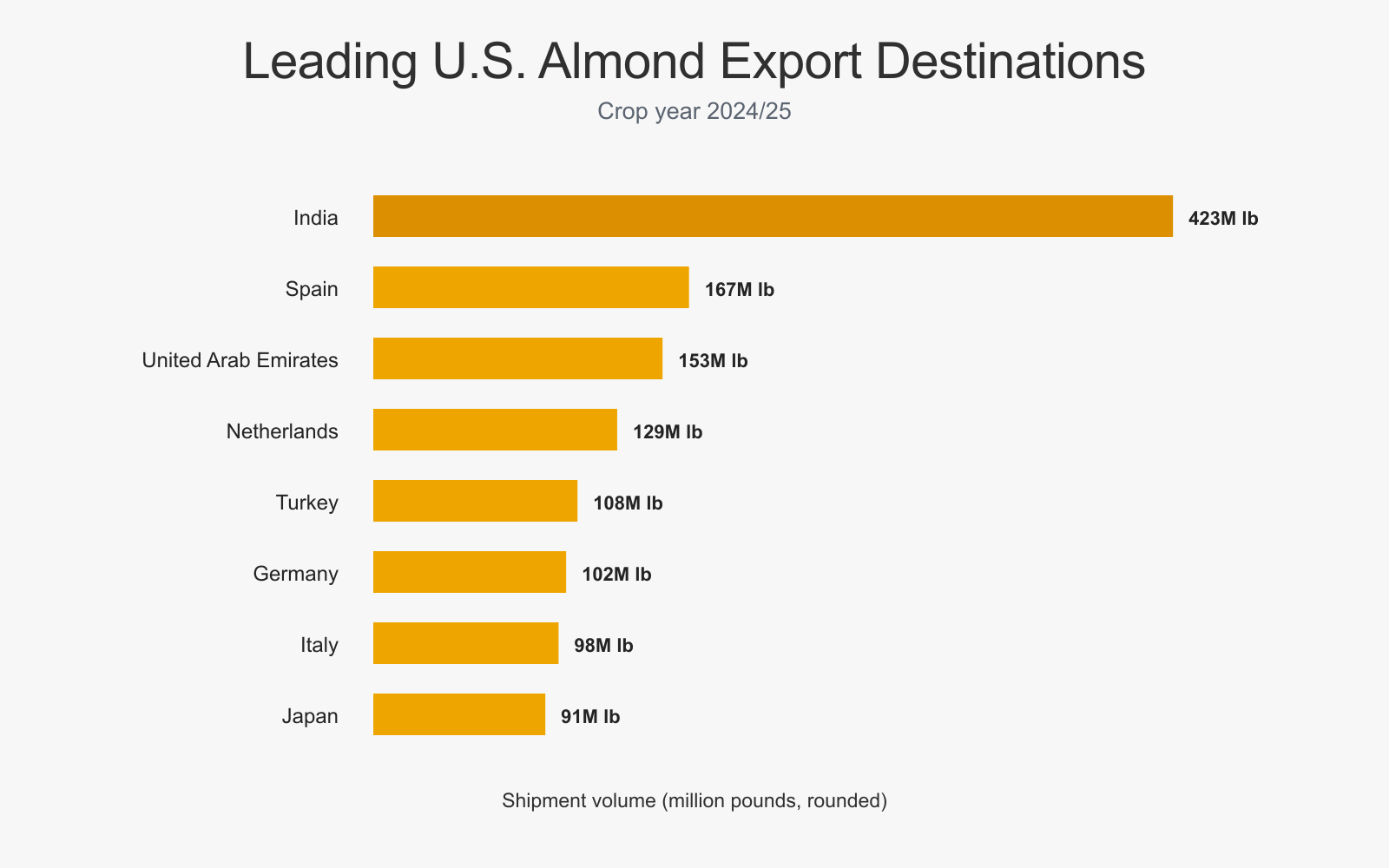
Volume alone should not decide the target market. Compare the form demanded, tariff and tax burden, certificate complexity, payment risk, seasonality, and buyer concentration before spending on samples or inventory.
A shipment-ready almond export checklist
- Lock the product specification, pack, lot, and shelf life.
- Confirm Schedule B and destination tariff classification.
- Obtain the import permit or official destination requirements.
- Screen every transaction party and verify the buyer.
- Agree the Incoterm, payment, claims process, and shipment window.
- Book the handler, laboratory, inspection, treatment, and freight slots.
- Apply for the phytosanitary certificate when required.
- Approve the label and build draft shipping documents.
- File EEI and obtain the ITN when required.
- Inspect, load, seal, photograph, and reconcile final weights.
- Send the buyer's document pack before arrival and track clearance.
How Exim Data Hub supports market selection
Compliance gets the shipment across the border; buyer intelligence determines whether the commercial effort is worthwhile. Exim Data Hub helps teams compare active destinations, find recent almond importers, review shipment frequency, and study how competing origins serve the same buyers. Use those signals to build a qualified prospect list—not as a substitute for official customs, plant-health, or food rules.
Frequently Asked Questions (FAQ)
Q1: What is the Schedule B code for almonds?
The 2026 Schedule B lists 0802.11.0000 for almonds in shell and 0802.12.0000 for shelled almonds. Processed products may use a different code.
Q2: Do U.S. almond exports need a special export license?
Most ordinary commercial food shipments do not need a product-specific Commerce license, but the exporter must check destination restrictions, end use, and every transaction party. A license or other authorization can still be required in restricted cases.
Q3: Is a phytosanitary certificate always required?
No. The requirement depends on the destination and product form. Confirm the official destination condition in ACIR and the buyer's import permit before shipment.
Q4: When is EEI required?
It is generally required when the value under one Schedule B number exceeds USD 2,500 for the relevant shipment, or when another mandatory filing condition applies. Check the current Foreign Trade Regulations for the actual route and transaction.
Q5: Which market received the most U.S. almonds in 2024/25?
India led the Almond Board's 2024/25 destination table with 423 million pounds.